

Guess the simplest way to put it is time..
With time I’ve realized none of this is real .
You grow up learn a bunch of bullshit & have to reteach yourself truth .
With time you begin to drift away, in your own little bubble …
People aren’t as interesting anymore, mindsets differ and cause relationships to no longer exist .
With time I realized just because a person has the same material possessions that you do doesn’t mean they’re rich … Hell I’m not rich , looking wealthy is appealing , but it too is all an illusion .
With time you realize some men aren’t interested in you . They’re more interested in how others will view them if they have you on their arm.
With time… Wearing heels seem like the silliest thing to do… Everyone knows you’re uncomfortable , especially you .
With time knowing everything about a celebrity yet nothing about your own culture is similar to swallowing poison slowly .. Killing yourself ..
With time you see that people do everything they see on TV. Television Programs literally program the human mind .
With time you realize you can’t expect people to listen to what you have to say and thoroughly respect your mind when you have your boobs out all the time .
With time you learn to act from your heart, your mind wants to be your master … Don’t let it all the time .
With time you come to grips with the fact that the people that care about how you feel the most usually are the ones you end up taking for granted .
With time life gets easier , and harder at the same damn time .
With time you see all your goals get achieved then realized there’s still so much work to do on the inside because all the outside accomplishments still left you with a void.
With time you love less .
With time you love more.
With time , time goes by faster …
With time the past seems like a dream, it happened but it no longer affects you .
With time I still find myself finding myself, and losing myself .
With time I’m still learning to love and appreciate all God has given and not given me .
With time , I now see that average is beautiful.
With time I see that what is, is what shall be .
Too much schooling ruins a woman?
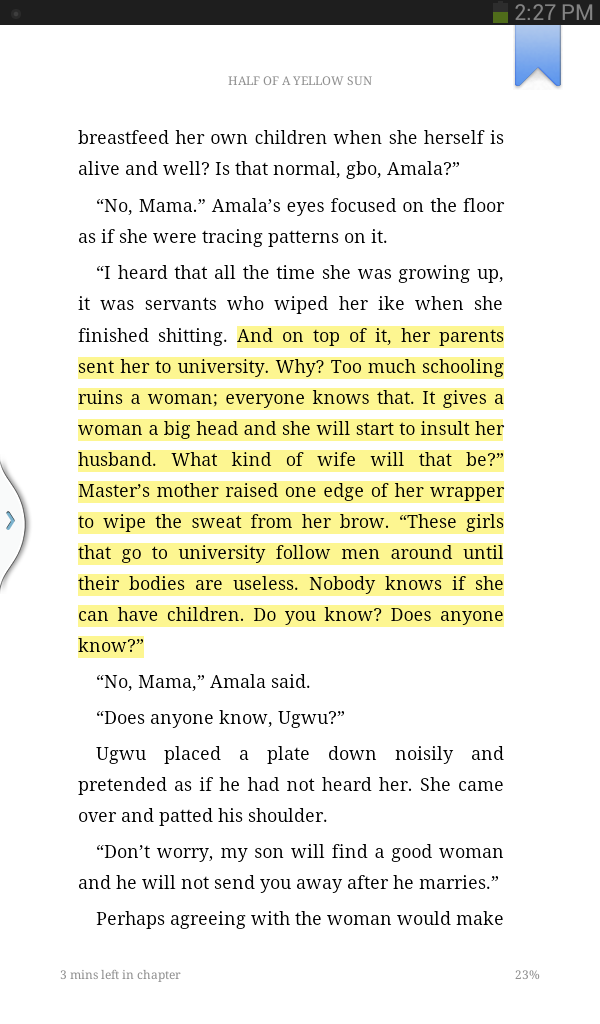
I came across this excerpt while reading Chimamanda Ngozi Adiche’s Half of A Yellow son and thought it would be interesting to play devils advocate by mentally speculating on the idea that too much schooling ruins a woman.
“’Question everything’ they said, ‘Why’, you asked’”
Today we live in a technological society where social media is generally ubiquitous and controls a great deal of our beliefs. Not only are we bits and pieces of the people we interact with or the books we read but we are also fragments of ideas or viewpoints that we have come across on social media outlets. Rarely are our opinions completely original, instead they are often borrowed and morphed into our own. I then often find myself asking if people take the time to ponder these beliefs that they allow into their precious and delicate minds. I believe W. K. Clifford was justified in his assertion that “it is wrong always, everywhere, and for anyone, to believe anything upon insufficient evidence” and that people should essentially question everything. Doubt is something that one should welcome rather than fear because doubt in and of itself creates stronger and more solidified beliefs that are grounded on justifiable evidence. When a man holds a certain opinion and has doubts that prey upon his mind, and goes on to combat these doubts with impregnable assertions he has created a stronger opinion. However, the man that holds an opinion tightly locked up in his mind with no room for skepticism is a man that potentially harbors a weak opinion and puts himself in danger. Socrates said it best when he stated, “It is the mark of an educated mind to be able to entertain a thought without accepting it.” A truly educated man is able to query his beliefs not only for peace of mind but also as a moral duty. Things such as faith fall into another realm.
In aspects of humans being social beings and working together for the greater good we must engage in the task of filtering the posterity that becomes the world we live in. We do this by challenging the way we think and dissecting traditional views that have been passed down for generations.
“But forasmuch as no belief ever held by one man, however seemingly trivial the belief, and however obscure the believer, is ever actually insignificant or without its effect on the fate of mankind, we have no choice but to extend our judgment to all cases of belief whatever. Belief, that sacred faculty which prompts the decisions of our will, and knits into harmonious working all the compacted energies of our being, is ours not for ourselves, but for humanity.” (52)
Doing what we think is moral or right isn’t enough and the end does not always justify the means. We can often times find ourselves to be misguided with our intentions when the action carried out is deemed as wrong but the intentions are good. The intention of an action does not matter because at the end of the day the action will always be right or wrong and the deed will have already been done. If the actions committed were judged as right and ended up being favorable, yet the beliefs behind these actions were ones untouched by doubt or sound evidence propping up said belief then the right action is discredited.
This is where the question of defining what is right and what is wrong comes in to play. As Clifford states, the question of right or wrong has to do simply with the origin of the belief and how it was obtained—on solid grounds backed with evidence or unstable grounds filled with unanswered doubts. Believing fervently in something is not enough to sustain ones actions. I shall use the relationship of mother and child as an example: If a mother believes in her heart that she is raising a healthy son that is mentally stable, yet her son has been exhibiting traits of psychopathy and she then goes to send him off to a college campus amidst thousands of people without getting him checked by a psychiatrist out of fear and the misguided truth that her son is fine, then she is wrong. The mother had no wicked intentions to put people in harms way. She was simply a mother blinded by her love for her son and in denial of his condition. Nevertheless, her son could go off to the campus and commit numerous acts of homicide out of an undiagnosed and untreated mental illness. Or the son could go off to college and not harm anyone. Either way the mother is wrong for stifling her doubts rather than inquiring of sound proof to support her belief that her son is fine.
Another question that may arise is that of what makes someone credible to ask a question and make inquiries on certain beliefs? If you’re going to question something shouldn’t you have a background that provides you with the wisdom to answer it? The answer is in the question itself; any man that is capable of asking a question is capable of answering it through garnered proof to attain as to whether the initial thought is sustained or changed.
What are your beliefs if you question everything? This is a question that is in many ways applicable to the lot that refuse to question their beliefs out of the feeling of knowledge and power they get from acquiring beliefs on unstable grounds. A man is born unto this earth with no beliefs, however through social contact and the development of his cognition he learns to think for himself [or not] and acquire information. Whether it comes from social media, culture, family, or religion—opinions, biases, and ideals are formed. In order to keep these ideals as “truths that have been established by long experience and waiting toil, and which have stood in the fierce light of free and fearless questioning” (52) we must welcome questions and disapproving statements.
Just as iron sharpens iron, so one man sharpens another through the wisdom and knowledge that he passes on to his posterity and essentially humanity. The importance of thinking for oneself and questioning everything cannot be exaggerated enough. The advice that comes your way, or the seemingly trivial thoughts that occur in your head should be able to withstand second thoughts and criticism. In todays society with all the social media outlets we have its easy to be swayed one way or another without really taking the time to question the beliefs we are letting into our minds and putting into action. As W. K. Clifford said,
“No real belief, however trifling and fragmentary it may seem, is ever truly insignificant; it prepares us to receive more of its like, confirms those which resembled it before, and weakens others; and so gradually it lays a stealthy train in our thoughts, which may someday explode into overt action and leave its stamp upon our character forever”
As to the obvious question in opposition, which is what happens when doubt is not entertained, the answer is simple– man ends up poisoning the mind of people. A perfect often clichéd example is Adolf Hitler. I could have easily made up an example but I chose to use this one because of the historical significance that it weighs down upon society today. This example is perfect in every way of showing how one man with misguided judgment can go on to poison the minds of others resulting in the mass genocide. If you entertain and harbor false or unproven beliefs what else are you capable of? You’re unwittingly harming society It’s the idea of stifling doubts that ruins mans credibility and makes him unfit to believe.
I may even be ugly, but dear God, I am here
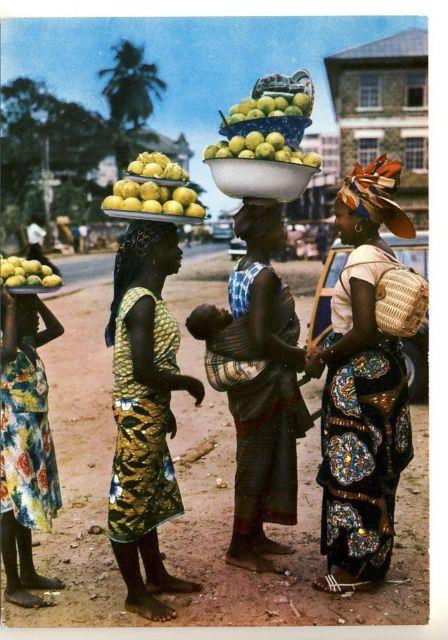
How are we today, Sister?
-I am ugly, but I am here.
“There is a Haitian saying which might upset the aesthetic images of most women. Nou led, Nou la, it says. We are ugly, but we are here. Like the modesty that is somewhat common in Haitian culture, this saying makes a deeper claim for poor Haitian women than maintaining beauty, be it skin deep or otherwise. For most of us, what is worth celebrating is the fact that we are here, that we against all the odds exist. To the women who might greet each other with this saying when they meet along the countryside, the very essence of life lies in survival. It is always worth reminding our sisters that we have lived yet another day to answer the roll call of an often painful and very difficult life. It is in this spirit that to this day a woman remembers to name her child Anacaona, a name which resonates both the splendor and agony of a past that haunts so many women.
When they were enslaved, our foremothers believed that when they died their spirits would return to Africa, most specifically to a peaceful land we call Guinin, where gods and goddesses live. The women who came before me were women who spoke half of one language and half another. They spoke the French and Spanish of their captors mixed in with their own African language. These women seemed to be speaking in tongue when they prayed to their old gods, the ancient African spirits. Even though they were afraid that their old deities would no longer understand them, they invented a new language our Creole patois with which to describe their new surroundings, a language from which colorful phrases blossomed to fit the desperate circumstances. When these women greeted each other, they found themselves speaking in codes.
How are we today, Sister?
-I am ugly, but I am here.
My grandmother believed that if a life is lost, then another one springs up replanted somewhere else, the next life even stronger than the last. She believed that no one really dies as long as someone remembers, someone who will acknowledge that this person had in spite of everything been here. We are part of an endless circle, the daughters of Anacaona. We have stumbled, but have not fallen. We are ill-favored, but we still endure. Every once in a while, we must scream this as far as the wind can carry our voices: We are ugly, but we are here! And here to stay.”
— WE ARE UGLY, BUT WE ARE HERE, Edwidge Danticat from The Caribbean Writer, Volume 10 (1996)
 tobiowoyemi's Blog